
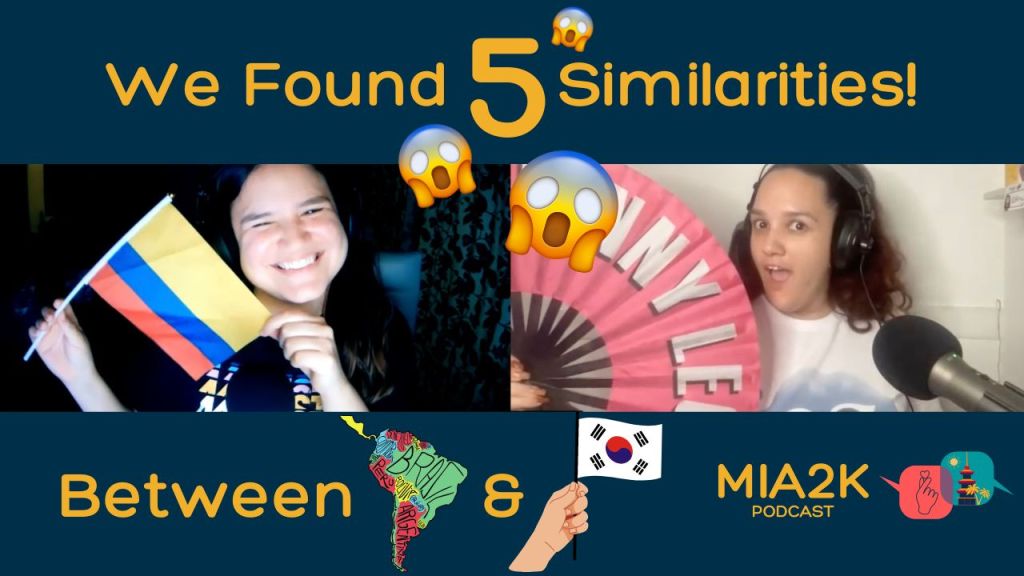
A few weeks ago we hit you guys with all the differences between western and eastern entertainment, but while we were doing that episode we realized something beautiful: there are actually many similarities between South Korean and Latin American cultures.
And what better time than Hispanic Heritage Month to do a deep dive on all the parallels we’ve found so far? We’re still riding high on our cloud from being featured on the Apple Podcasts collection called “El Vecindario,” so let’s start finding some common ground. Vamonos!
Listen here:
1. Focus on appearance/visual appeal
The way everyone is into good skin and perpetual youth in South Korea, we also saw that growing up. Our moms, tias, abuelas, etc. taught us the importance of looks from an early age, and we had to always be presentable for “la visita” (anyone coming over) but even more whenever we left the house, even to the pharmacy. Colombia, Venezuela, and Brazil are known for plastic surgeries, as is South Korea.
2. TV Humor
The base level humor for South Korean variety shows is a relative match to what we saw in Latin America growing up, and much of it remains today. It’s a lot of relaxed, easy humor that you can just laugh as you mindlessly watch TV, and doesn’t require a ton of attention.
For contrast, in the U.S., TV humor is much more satirical and sarcastic in nature, and show hosts do everything possible to bring current events into the conversation and produce elaborate jokes that might be finished at the end of the episode. It’s comedy stand-up, but for TV.
3. Rice as an irreplaceable item in every meal
We know this may not be the case for all of Latin America, but at least for us in Colombia and Venezuela, a meal without rice is not a meal. It’s how us and everyone around us grew up. And the same seems to be the case throughout Asia, particularly in China, Japan, and South Korea. The only difference is that for us, rice is considered fattening and so when we all start our diets, white rice tends to be first out of our “to eat” lists.
4. Boy bands
This point was completely inspired by this TikTok. How dare our moms judge our love of KPop groups when they stanned Menudo? For those of you who are unfamiliar, Ricky Martin started out in a boy band named Menudo, and they wore the equivalent of hair/makeup/tight clothes we get from KPop idol groups today. Their biggest hit that lives on to this day is this gem called “Subete a mi moto” (Get on my bike). Popular singer Chayanne came up through another aesthetically similar Puerto Rican boy band that disbanded in 1984 called Los Chicos (what’s up The Boyz? Everything comes back into fashion!).
5. Folklore
Although rhythmically they’re completely different, the spirit behind trot, joropo, and vallenato as national music genres is noticeable. They’re definitely sitting at the same table when they go to the genres party. They’re also mostly only relevant domestically very little exposure internationally, and even at a national level they’re very niche genres as well. Most of the songs in this genre are romantic in nature as well.
Bonus round: South Korea and… Florida?!
It’s not just in our heritage as Hispanic/Latin women that we found common ground with South Korea. Although all of the aforementioned points are culture-based, we realized that geographically speaking, there’s some overlap between Florida and South Korea:
- Both peninsulas
- Both experience similar climate phenomenon in the summer (hurricanes vs. typhoons)
- We’re located at *close(ish)* latitudes at 35 and 27 degrees for South Korea and Florida respectively (the real comparable city to Seoul is Washington D.C.)
Ok, fine. That last one may have been a reach, but with the 13-14 hour/time zone difference we’ll grasp onto anything that makes us feel a little closer.
And with that, we rounded out our episode on similarities between South Korea and Latin America! Had you thought about any of these before? Were you surprised by any of them? Are there some we didn’t pick up on from different countries in the region?
Watch our episode below for the full visual experience:
 MIA2K: A K-Pop Podcast
Leave a comment