
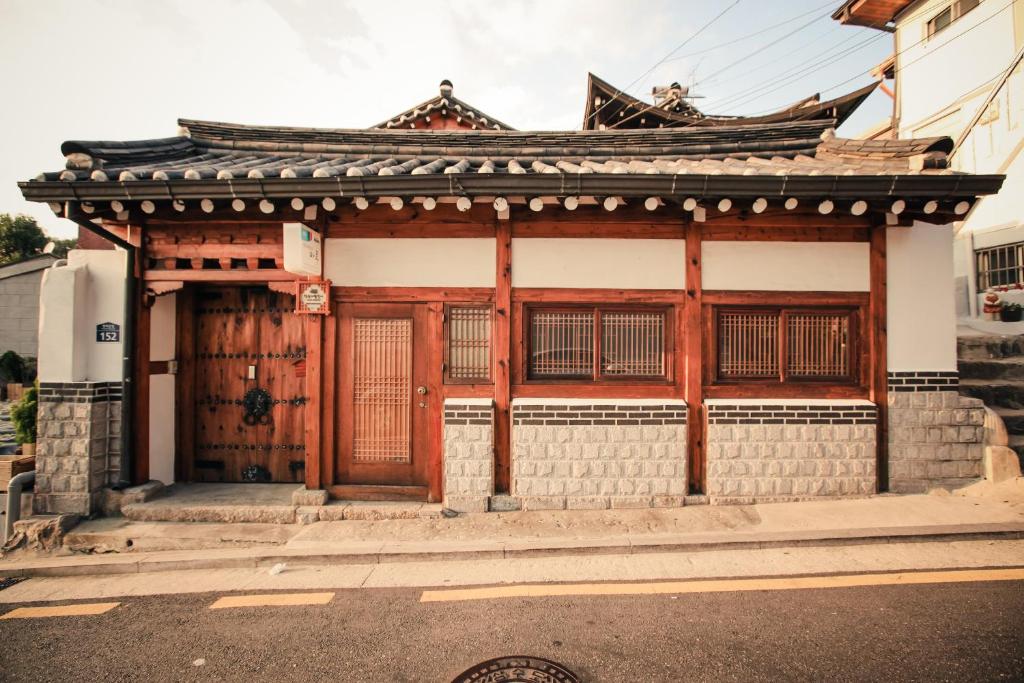
This post was not paid for or written in exchange for our stay or any other service. We paid for our room and are simply sharing our experience so others know what to expect. We genuinely enjoyed our stay 🙂
***
Have you ever pondered whether you should stay at a hanok or traditional Korean house while in South Korea?
While we only went to one, our experience was pretty wonderful so we would unequivocally say: yes, you should!
Booking a hanok
Many hanoks are available for booking on standard hotel sites like booking.com or expedia.com. This is a good sign that they are foreigner friendly, and precisely how we found ours.
Our first priority when booking our hanok was that it had to have a private bathroom and the bathroom had to be modern. We’re willing to try many new things, but bathroom-sharing isn’t one of those things. You have to know what you’re comfortable with and then narrow down your search based on that.
Our hanok, Bukchonmaru Guesthouse (found easily on both Expedia and booking.com), had a mix of options between private rooms with ensuite bathrooms and regular rooms that share a bathroom.
Once we found our hanok, we knew that we would be arriving earlier than the standard check-in time, so we messaged them in advance to ensure that we could at least drop our bags off, to which they replied that we could, so we proceeded with our booking.
Getting to the hanok
South Korea’s more traditional areas are typically on hills or hill-adjacent, so we recommend taking the time to check your transportation options before your trip. In our case, our hanok was fully atop a hill, and fortunately the bus stop was right across from its door. We couldn’t imagine being dropped off just a few blocks away and having to make that climb with carry-on bags and backpacks on us.
We landed at Gimpo airport in Seoul from Jeju-Do on a Thursday close to noon. Following the directions from the Naver Maps app, we took the metro into the city (close to an hour) and then transferred to one of the green buses that traverse Bukchon Hanok Village. As we mentioned, the bus dropped us off right in front of Bukchonmaru Guesthouse, around 1:30pm.
Bukchonmaru Guesthouse’s family
Although it may not always be the case, many guesthouses are run by families who live on the property and have made accommodations to rent out the top floors as hotel rooms. In the case of Bukchonmaru, it is definitely a family-run, cozy home environment that helps drive any homesickness away.
The mom of the house is a lovely and very active woman who uses apps like Papago or Google translate on her phone to communicate with guests. She is an absolute joy and does her best to get to know the guests during their stay. From what we understood, her son is married to an American and lives in the US, so she’s particularly fond of American travelers (which everyone assumed we were from just looking at us). She has a daughter who is a bit more familiar with English, and just so sweet. They helped us carry our bags up into our room and showed us how to use the lock and key to safeguard our room and belongings.

They were really kind to not just let us drop off our bags but even allowed us to go into the room since we had to change and fix ourselves up to go do a photoshoot in hanboks at Gyeongbok Palace. We may have just gotten lucky because it seemed like a very active day at the hanok, as the whole upstairs area was getting cleaned and they were making kimchi for the winter.
Amenities and services
We only stayed in the hanok for one night to have the experience, so we didn’t get to use every single available space or service. With that said, we can definitely provide a breakdown of what we did experience:
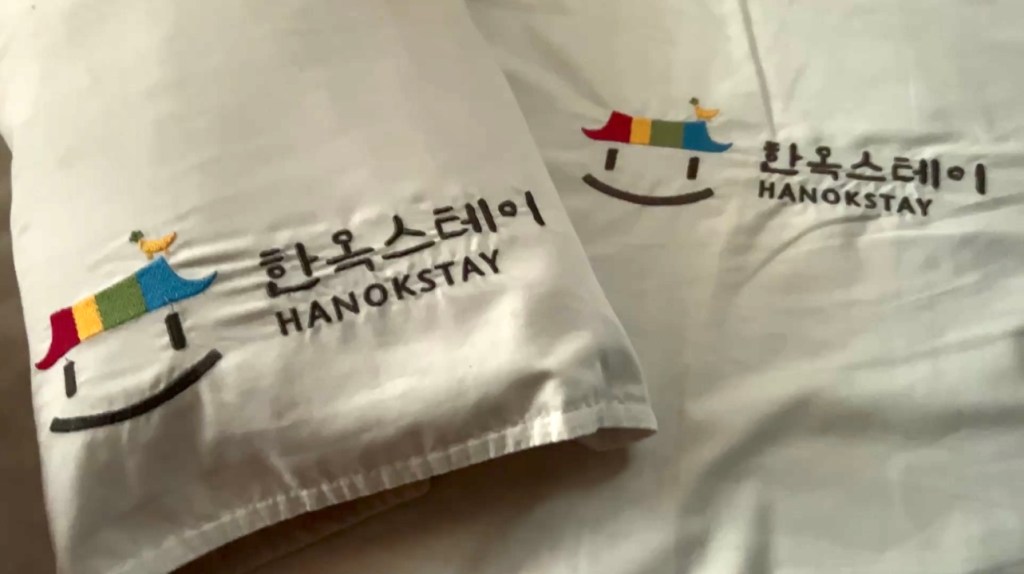
- The room: we stayed at room 103, which has a private modern bathroom, a desk, air conditioning, a beautiful armoire, and heated floors. The beds are traditional floor mattresses that fold in 3. There is a small pillow in a cute embroidered cover, and you are given a colorful traditional duvet to shelter from the cold. Our only complaint is that we couldn’t figure out how to adjust the a/c, so it wasn’t cold enough for us and since the floor heating was on, we were a bit hot throughout the night. It was November, so typically a/c wouldn’t be needed, but we both run pretty hot so we wished we could’ve turned it down just a bit. The windows do have screens, but they’re not perfectly fitted to the frames, so we did get a few mosquito bites throughout the night. The floor mattresses were surprisingly very good for our backs, especially since by this point we had been in South Korea for a full week trekking along, so although unusual, it was a very welcome change. The bathroom was as expected, with the standard shower head over the sink. It was an authentic yet comfortable experience.
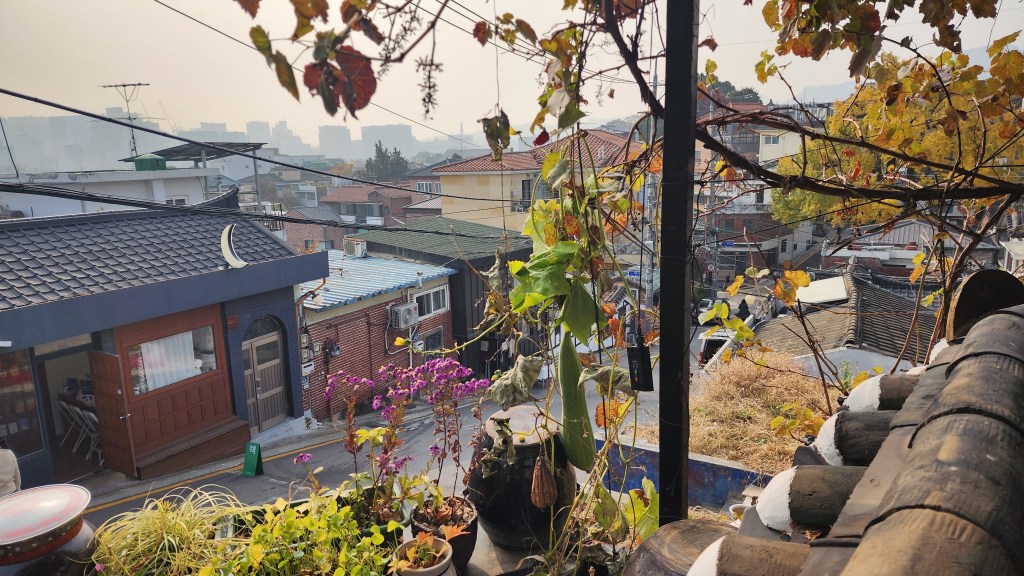
- The balcony/garden: we didn’t spend a ton of time here, but waking up in the morning to overlooking Seoul neighborhoods and hills from this POV was an amazing start to our day. They had zucchini growing from a few planters and the vines just added so much charm to the structure. This is where they were making kimchi when we arrived.
- Washing machine: since we had been in South Korea for a week and traveling with carry-ons, we brought limited clothes and were starting to run out of things we could reuse. We were planning on using the washer at the hanok, but we were kind of concerned that it would be a small machine. Thankfully, our worries were unfounded as they have an industrial machine (makes sense, for all the sheets!) and they also had a dryer! With the help of our house mom, we were able to put both of our loads in at the same time, with plenty of space to spare for more clothes if needed. Since it was nighttime when we did our laundry, the house mom showed us how to operate both machines to get our clothes through the drying cycle (all through sign language, Papago, and some broken Korean from us). We did one dryer cycle (lasted 41 minutes) which left our clothes not quite wet but still pretty damp. We decided to use all the hangers in the room to open them up, and we also had the – we think – brilliant idea to stretch some of the clothes out on the floors of our room since they were heated, which definitely helped with the drying process.
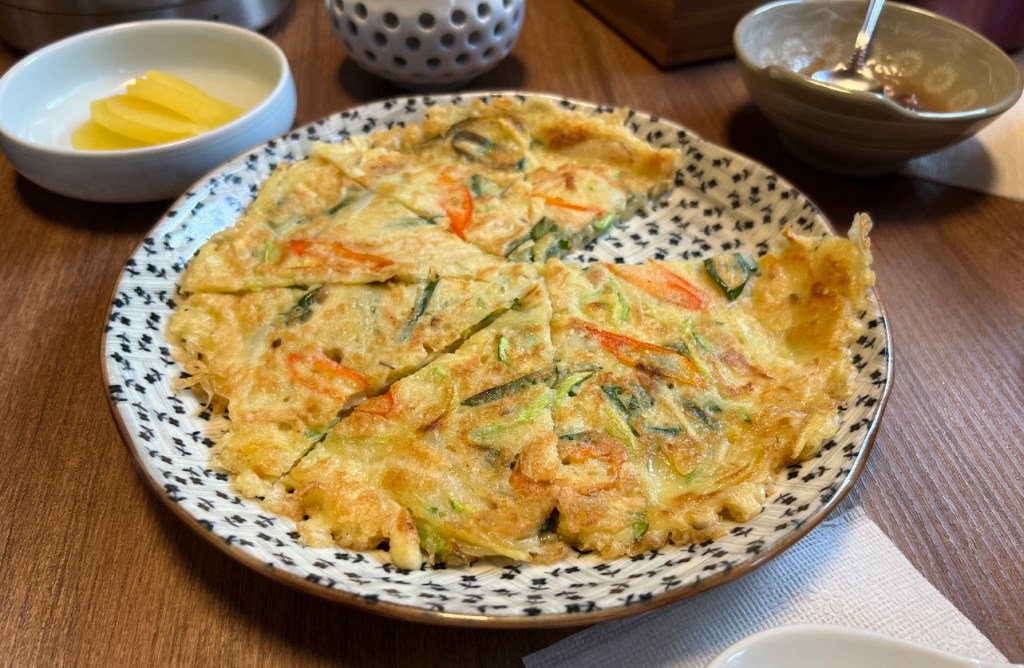
- Breakfast: breakfast at the hanok is included in the nightly booking fee. They have a small dining room right at the entrance of the hanok which can hold about 2 rooms at a time. For our breakfast, there was another friend duo sitting at the breakfast room already, and we had a great conversation with them. The breakfast included coffee, Korean pancakes, and a soup which contained pumpkin and beans. All of it was very savory, and they offered seconds if we wanted them!
The end of our stay
We checked out around 9:30am as we had to transfer to our hotel where we’d stay for the rest of our Seoul leg and head to another activity we had booked. The family was so sweet and we felt genuinely sad to leave. We asked them for help calling a cab (we experienced better and faster response times when the cabs were called by Korean people who helped us), and they sent us off with infinite thanks for staying with them and well wishes to make it home safely despite the pandemic. We were ready to hand over our adoption papers to be taken in permanently, but no such luck this time.
All in all, our stay at Bukchonmaru Guesthouse was one of the best decisions we made when we planned our trip to South Korea (our planning blog and podcast episodes can be found here for part 1 and here for part 2). We also made a short recap video of our stay for your enjoyment over on the clock app!
If when you started reading this you were apprehensive about a hanok stay, we hope this blog erased all doubt for you!
 MIA2K: A K-Pop Podcast
Leave a comment